HOME
SIGN UP LOGIN
https://1828.mshaffer.com
Wednesday - December 3, 2025

In my view, the Christian religion is the most important and one of the first things in which all children, under a free government ought to be instructed... No truth is more evident to my mind than that the Christian religion must be the basis of any government intended to secure the rights and privileges of a free people.
- Preface

1828 Noah Webster Dictionary
  A B C D E F G H I J K L M N O P Q R S T U V W X Y Z   <3

Search, browse, and study this dictionary to learn more about the early American, Christian language.

1828.mshaffer.comWord [forage]

0
0
Cite this! Share Definition on Facebook Share Definition on Twitter Simple Definition Word-definition Evolution

forage

FOR'AGE, n. [L. voro.]

1. Food of any kind for horses and cattle, as grass; pasture, hay, corn and oats.

2. The act of providing forage.

Col. Mawhood completed his forage unmolested.

If the forage is to be made at a distance from the camp -

3. Search for provisions; the act of feeding abroad.

FOR'AGE, v.i.

1. To collect food for horses and cattle, by wandering about and feeding or stripping the country.

2. To wander far; to rove. Obs.

3. To ravage; to feed on spoil.

FOR'AGE, v.t. To strip of provisions for horses, &c.


Evolution (or devolution) of this word [forage]

1828 Webster1844 Webster1913 Webster

FOR'AGE, n. [L. voro.]

1. Food of any kind for horses and cattle, as grass; pasture, hay, corn and oats.

2. The act of providing forage.

Col. Mawhood completed his forage unmolested.

If the forage is to be made at a distance from the camp -

3. Search for provisions; the act of feeding abroad.

FOR'AGE, v.i.

1. To collect food for horses and cattle, by wandering about and feeding or stripping the country.

2. To wander far; to rove. Obs.

3. To ravage; to feed on spoil.

FOR'AGE, v.t. To strip of provisions for horses, &c.


FOR'AGE, n. [Fr. fourrage; Arm. fouraich; It. foraggio; Sp. forrage; Port. forragem; D. voeraadge. If this word signifies primarily food or fodder, it is connected with W. pori, to feed, and L. voro. But I take it to be from the root of Sax. faran, to go and primarily to signify that which is collected in wandering, roving, excursion. In Port. foragido is a vagabond, and forrejar is to waste, to ravage.]

  1. Food of any kind for horses and cattle, as grass, pasture, hay, corn and oats.
  2. The act of providing forage. Col. Mawhood completed his forage unmolested. Marshall. If the forage is to be made at a distance from the camp. Encyc.
  3. Search for provisions; the act of feeding abroad. Milton.

FOR'AGE, v.i.

  1. To collect food for horses and cattle, by wandering about and feeding or stripping the county. Marshall.
  2. To wander far; to rove. [Obs.] Shak.
  3. To ravage; to feed on spoil. Shak.

FOR'AGE, v.t.

To strip of provisions for horses, &c. Encyc.


For"age
  1. The act of foraging; search for provisions, etc.

    He [the lion] from forage will incline to play. Shak.

    One way a band select from forage drives
    A herd of beeves, fair oxen and fair kine.
    Milton.

    Mawhood completed his forage unmolested. Marshall.

  2. To wander or rove in search of food] to collect food, esp. forage, for horses and cattle by feeding on or stripping the country; to ravage; to feed on spoil.

    His most mighty father on a hill
    Stood smiling to behold his lion's whelp
    Forage in blood of French nobility.
    Shak.

    Foraging ant (Zoöl.), one of several species of ants of the genus Eciton, very abundant in tropical America, remarkable for marching in vast armies in search of food. -- Foraging cap, a forage cap. -- Foraging party, a party sent out after forage.

  3. To strip of provisions; to supply with forage; as, to forage steeds.

    Pope.
  4. Food of any kind for animals, especially for horses and cattle, as grass, pasture, hay, corn, oats.

    Dryden.

    Forage cap. See under Cap. -- Forage master (Mil.), a person charged with providing forage and the means of transporting it. Farrow.

1828 Webster1844 Webster1913 Webster

Thank you for visiting!

  • Our goal is to try and improve the quality of the digital form of this dictionary being historically true and accurate to the first American dictionary. Read more ...
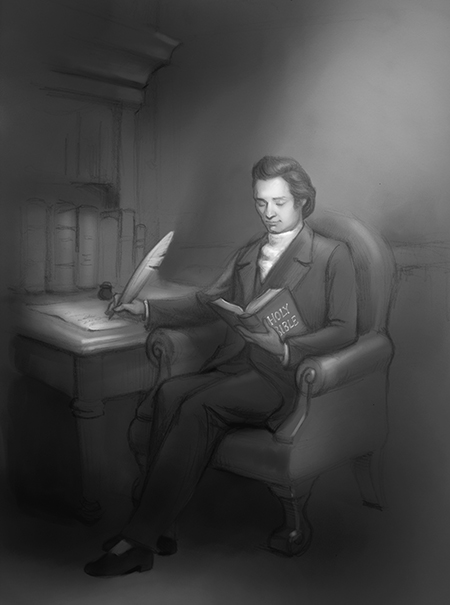
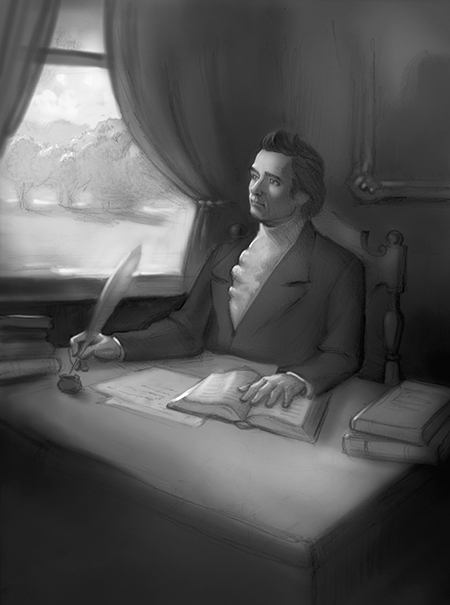
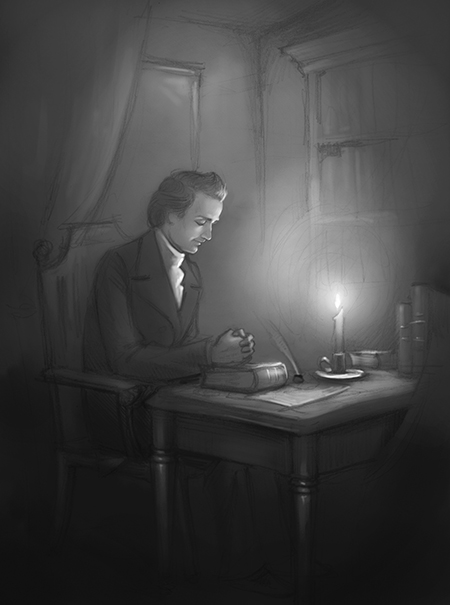
  • Below you will find three sketches from a talented artist and friend depicting Noah Webster at work. Please tell us what you think.
Divine Study
  • Divine StudyDivine Study
    Divine Study
Window of Reflection
  • Window of ReflectionWindow of Reflection
    Window of Reflection
Enlightening Grace
  • Enlightening GraceEnlightening Grace
    Enlightening Grace

159

932

111

1018

186

1047
Forage

FOR'AGE, noun [Latin voro.]

1. Food of any kind for horses and cattle, as grass; pasture, hay, corn and oats.

2. The act of providing forage

Col. Mawhood completed his forage unmolested.

If the forage is to be made at a distance from the camp -

3. Search for provisions; the act of feeding abroad.

FOR'AGE, verb intransitive

1. To collect food for horses and cattle, by wandering about and feeding or stripping the country.

2. To wander far; to rove. obsolete

3. To ravage; to feed on spoil.

FOR'AGE, verb transitive To strip of provisions for horses, etc.

Why 1828?

Word of the Day

importance

IMPORT'ANCE, n.

1. Weight; consequence; a bearing on some interest; that quality of any thing by which it may affect a measure, interest or result. The education of youth is of great importance to a free government. A religious education is of infinite importance to every human being.

2. Weight or consequence in the scale of being.

Thy own importance know.

Nor bound thy narrow views to things below.

3. Weight or consequence in self-estimation.

He believes himself a man of importance.

4. Thing implied; matter; subject; importunity. [In these senses, obsolete.]

Random Word

best

BEST, a. superlative. [Eng.but;] Literally, most advanced, Hence,

1. Most good; having good qualities in the highest degree; applied indifferently to physical or moral subjects; as, the best man; the best road; the best cloth; the best abilities. This, like most, and other attributes, is often used without its noun, when the noun is obvious; as, men are all sinners; the best of them fail in the performance of duty.

2. Most advanced; most accurate; as the best scholar.

3. Most correct or complete; as the best view of a landscape, or of a subject.

4. The best. This phrase is elliptical, and may be variously interpreted; as, the utmost power; the strongest endeavor; the most, the highest perfection; as, let a man do his best; let him do a thing to the best of his power.

5. At best, in the best manner, in the utmost degree or extent, applicable to the case; as, life is at best very short.

To make the best of, to carry to its greatest perfection; to improve to the utmost; as, to make the best of a sum of money, or a piece of land. Also, to permit the least possible inconvenience; as, to make the best of ill fortune or a bad bargain.

The best of the way. We had made the best of our way to the city; that is, the most, the greatest part of the distance. [This is the primary sense of the word.]

BEST, adv. In the highest degree; beyond all other; as, to love one best; to like this best; to please best.

1. To the advantage; with the most ease; as,"which instrument can you best use?"

2. With most profit or success; as, money is best employed in manufactures; this medicine will answer best in the present case.

3. Most intimately or particularly; most correctly; as, what is expedient is best known to himself.

Noah's 1828 Dictionary

First dictionary of the American Language!

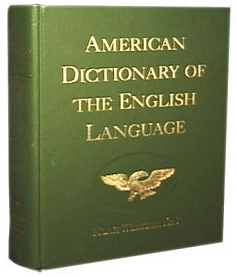
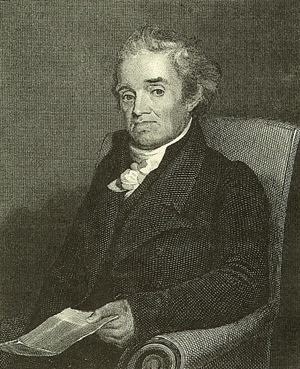
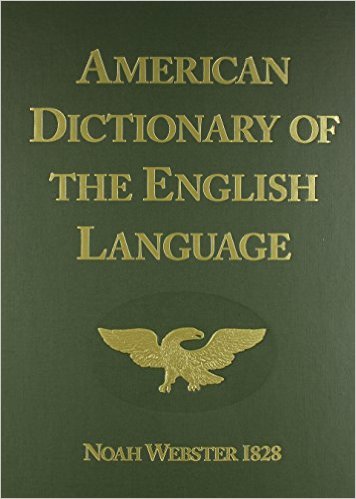
Noah Webster, the Father of American Christian education, wrote the first American dictionary and established a system of rules to govern spelling, grammar, and reading. This master linguist understood the power of words, their definitions, and the need for precise word usage in communication to maintain independence. Webster used the Bible as the foundation for his definitions.

This standard reference tool will greatly assist students of all ages in their studies.

No other dictionary compares with the Webster's 1828 dictionary. The English language has changed again and again and in many instances has become corrupt. The American Dictionary of the English Language is based upon God's written word, for Noah Webster used the Bible as the foundation for his definitions. This standard reference tool will greatly assist students of all ages in their studies. From American History to literature, from science to the Word of God, this dictionary is a necessity. For homeschoolers as well as avid Bible students it is easy, fast, and sophisticated.


Regards,


monte

{x:

Project:: 1828 Reprint


Hard-cover Edition

367

540

Compact Edition

353

242

CD-ROM

303

192

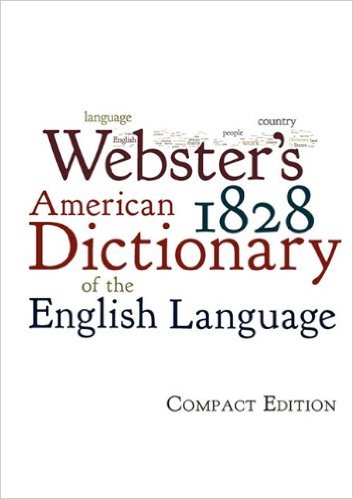
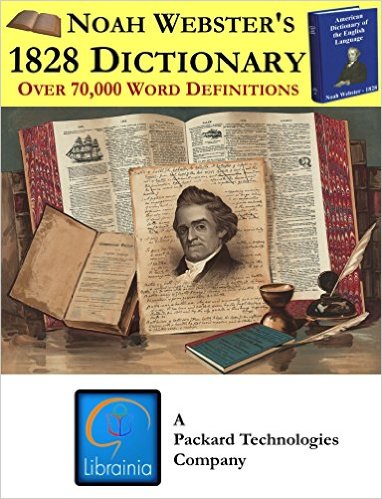
* As a note, I have purchased each of these products. In fact, as we have been developing the Project:: 1828 Reprint, I have purchased several of the bulky hard-cover dictionaries. My opinion is that the 2000-page hard-cover edition is the only good viable solution at this time. The compact edition was a bit disappointing and the CD-ROM as well.


[ + ]
Add Search To Your Site


Our goal is to convert the facsimile dictionary (PDF available: v1 and v2) to reprint it and make it digitally available in several formats.

Overview of Project

  1. Image dissection
  2. Text Emulation
  3. Dictionary Formatting
  4. Digital Applications
  5. Reprint

Please visit our friends:

{ourFriends}

Learn more about U.S. patents:

{ourPatent}

Privacy Policy

We want to provide the best 1828 dictionary service to you. As such, we collect data, allow you to login, and we want your feedback on other features you would like.

For details of our terms of use, please read our privacy policy here.

Page loaded in 2.874 seconds. [1828: 22, T:0]


1828 Noah Webster Dictionary

^ return to top
Back to Top