HOME
SIGN UP LOGIN
https://1828.mshaffer.com
Monday - January 19, 2026

In my view, the Christian religion is the most important and one of the first things in which all children, under a free government ought to be instructed... No truth is more evident to my mind than that the Christian religion must be the basis of any government intended to secure the rights and privileges of a free people.
- Preface

1828 Noah Webster Dictionary
  A B C D E F G H I J K L M N O P Q R S T U V W X Y Z   <3

Search, browse, and study this dictionary to learn more about the early American, Christian language.

1828.mshaffer.comWord [money]

0
0
Cite this! Share Definition on Facebook Share Definition on Twitter Simple Definition Word-definition Evolution

money

MONEY, n. plu. moneys.

1. Coin; stamped metal; any piece of metal, usually gold, silver or copper, stamped by public authority, and used as the medium of commerce. We sometimes give the name of money to other coined metals,and to any other material which rude nations use a medium of trade. But among modern commercial nations, gold, silver and copper are the only metals used for this purpose. Gold and silver, containing great value in small compass, and being therefore of easy conveyance, and being also durable and little liable to diminution by use, are the most convenient metals for coin or money, which is the representative of commodities of all kinds, of lands, and of every thing that is capable of being transferred in commerce.

2. Bank notes or bills of credit issued by authority, and exchangeable for coin or redeemable, are also called money; as such notes in modern times represent coin, and are used as a substitute for it. If a man pays in hand for goods in bank notes which are current, he is said to pay in ready money.

3. Wealth; affluence.

Money can neither open new avenues to pleasure, nor block up the passages of anguish.


Evolution (or devolution) of this word [money]

1828 Webster1844 Webster1913 Webster

MONEY, n. plu. moneys.

1. Coin; stamped metal; any piece of metal, usually gold, silver or copper, stamped by public authority, and used as the medium of commerce. We sometimes give the name of money to other coined metals,and to any other material which rude nations use a medium of trade. But among modern commercial nations, gold, silver and copper are the only metals used for this purpose. Gold and silver, containing great value in small compass, and being therefore of easy conveyance, and being also durable and little liable to diminution by use, are the most convenient metals for coin or money, which is the representative of commodities of all kinds, of lands, and of every thing that is capable of being transferred in commerce.

2. Bank notes or bills of credit issued by authority, and exchangeable for coin or redeemable, are also called money; as such notes in modern times represent coin, and are used as a substitute for it. If a man pays in hand for goods in bank notes which are current, he is said to pay in ready money.

3. Wealth; affluence.

Money can neither open new avenues to pleasure, nor block up the passages of anguish.

MON'EY, n. [plur. Moneys; Sax. mynet; D. munt, mint; G. münze; Sw. mynt; Dan. myndt, money or mint; Fr. monnoie; Ir. monadh; W. mwnai; Sp. moneda; Port. moeda, contracted; L. and It. moneta. Money and mint are the same word varied.]

  1. Coin; stamped metal; any piece of metal, usually gold, silver or copper, stamped by public authority, and used as the medium of commerce. We sometimes give the name of money to other coined metals, and to any other material which rude nations use as a medium of trade. But among modern commercial nations, gold, silver, platinum and copper are the only metals used for this purpose. Gold, platinum and silver, containing great value in a small compass, and being therefore of easy conveyance, and being also durable and little liable to diminution by use, are the most convenient metals for coin or money, which is the representative of commodities of all kinds, of lands, and of every thing that is capable of being transferred in commerce.
  2. Bank notes or bills of credit issued by authority, and exchangeable for coin or redeemable, are also called money; as such notes in modern times represent coin, and are used as a substitute for it. If a man pays in hand for goods in bank notes which are current, he is said to pay in ready money.
  3. Wealth; affluence. Money can neither open new avenues to pleasure, nor block up the passages of anguish. Rambler.

Mon"ey
  1. A piece of metal, as gold, silver, copper, etc., coined, or stamped, and issued by the sovereign authority as a medium of exchange in financial transactions between citizens and with government; also, any number of such pieces; coin.

    To prevent such abuses, . . . it has been found necessary . . . to affix a public stamp upon certain quantities of such particular metals, as were in those countries commonly made use of to purchase goods. Hence the origin of coined money, and of those public offices called mints. A. Smith.

  2. To supply with money.

    [Obs.]
  3. Any written or stamped promise, certificate, or order, as a government note, a bank note, a certificate of deposit, etc., which is payable in standard coined money and is lawfully current in lieu of it; in a comprehensive sense, any currency usually and lawfully employed in buying and selling.

    * Whatever, among barbarous nations, is used as a medium of effecting exchanges of property, and in the terms of which values are reckoned, as sheep, wampum, copper rings, quills of salt or of gold dust, shovel blades, etc., is, in common language, called their money.

  4. In general, wealth; property; as, he has much money in land, or in stocks; to make, or lose, money.

    The love of money is a root of all kinds of evil. 1 Tim vi. 10 (Rev. Ver. ).

    Money bill (Legislation), a bill for raising revenue. -- Money broker, a broker who deals in different kinds of money; one who buys and sells bills of exchange; -- called also money changer. -- Money cowrie (Zoöl.), any one of several species of Cypræa (esp. C. moneta) formerly much used as money by savage tribes. See Cowrie. -- Money of account, a denomination of value used in keeping accounts, for which there may, or may not, be an equivalent coin; e. g., the mill is a money of account in the United States, but not a coin. -- Money order, an order for the payment of money; specifically, a government order for the payment of money, issued at one post office as payable at another; -- called also postal money order. -- Money scrivener, a person who procures the loan of money to others. [Eng.] -- Money spider, Money spinner (Zoöl.), a small spider; -- so called as being popularly supposed to indicate that the person upon whom it crawls will be fortunate in money matters. -- Money's worth, a fair or full equivalent for the money which is paid. -- A piece of money, a single coin. -- Ready money, money held ready for payment, or actually paid, at the time of a transaction; cash. - - To make money, to gain or acquire money or property; to make a profit in dealings.

1828 Webster1844 Webster1913 Webster

Thank you for visiting!

  • Our goal is to try and improve the quality of the digital form of this dictionary being historically true and accurate to the first American dictionary. Read more ...
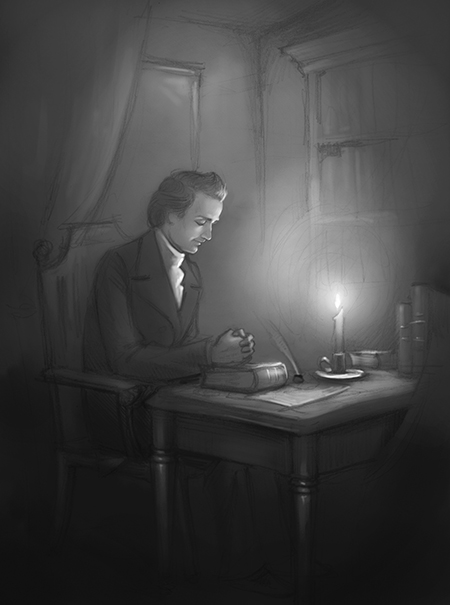
  • Below you will find three sketches from a talented artist and friend depicting Noah Webster at work. Please tell us what you think.
Divine Study
  • Divine StudyDivine Study
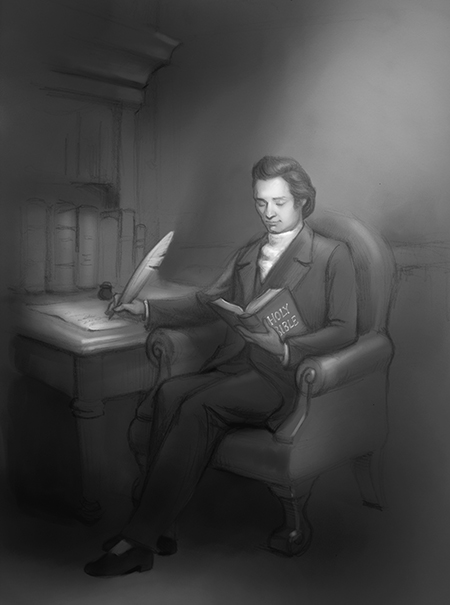
    Divine Study
Window of Reflection
  • Window of ReflectionWindow of Reflection
    Window of Reflection
Enlightening Grace
  • Enlightening GraceEnlightening Grace
    Enlightening Grace

160

938

114

1020

189

1056
Money

MONEY, noun plural moneys.

1. Coin; stamped metal; any piece of metal, usually gold, silver or copper, stamped by public authority, and used as the medium of commerce. We sometimes give the name of money to other coined metals, and to any other material which rude nations use a medium of trade. But among modern commercial nations, gold, silver and copper are the only metals used for this purpose. Gold and silver, containing great value in small compass, and being therefore of easy conveyance, and being also durable and little liable to diminution by use, are the most convenient metals for coin or money which is the representative of commodities of all kinds, of lands, and of every thing that is capable of being transferred in commerce.

2. Bank notes or bills of credit issued by authority, and exchangeable for coin or redeemable, are also called money; as such notes in modern times represent coin, and are used as a substitute for it. If a man pays in hand for goods in bank notes which are current, he is said to pay in ready money

3. Wealth; affluence.

MONEY can neither open new avenues to pleasure, nor block up the passages of anguish.

Why 1828?

Word of the Day

importance

IMPORT'ANCE, n.

1. Weight; consequence; a bearing on some interest; that quality of any thing by which it may affect a measure, interest or result. The education of youth is of great importance to a free government. A religious education is of infinite importance to every human being.

2. Weight or consequence in the scale of being.

Thy own importance know.

Nor bound thy narrow views to things below.

3. Weight or consequence in self-estimation.

He believes himself a man of importance.

4. Thing implied; matter; subject; importunity. [In these senses, obsolete.]

Random Word

sink

SINK, v. i. pret. sunk; pp. id. The old pret. sank is nearly obsolete.

1. To fall by the force of greater gravity, in a medium or substance of less specific gravity; to subside; opposed to swim or float. Some species of wood or timber will sink in water. Oil will not sink in water and many other liquids, for it is specifically lighter. I sink in deep mire. Ps. 69.

2. To fall gradually. He sunk down in his chariot, II Kings 9.

3. To enter or penetrate into any body. The stone sunk into his forehead. I Sam. 17.

4. To fall; to become lower; to subside or settle to a level. The Alps and Pyrenees sink before him.

5. To be overwhelmed or depressed. Our country sinks beneath the yoke.

6. To enter deeply; to be impressed. Let these sayings sink down into your ears. Luke 9.

7. To become deep; to retire or fall within the surface of any thing; as, the eyes sink into the head.

8. To fall; to decline; to decay; to decrease. A free state gradually sinks into ruin. It is the duty of government to revive a sinking commerce. Let not the fire sink or slacken.

9. To fall into rest or indolence; as, to sink away in pleasing dreams.

10. To be lower; to fall; as, the price of land will sink in time of peace.

SINK, v.t.

1. To put under water; to immerse in a fluid; as, to sink a ship.

2. To make by digging or delving; as, to sink a pit or a well.

3. To depress; to degrade. His vices sink him in infamy, or in public estimation.

4. To plunge into destruction. If I have a conscience, let it sink me.

5. To cause to fall or to be plunged.

6. To bring low; to reduce in quantity. You sunk the river with repeated draughts.

7. To depress; to overbear; to crush. This would sink the spirit of a hero.

8. To diminish; to lower or lessen; to degrade. I mean not that we should sink our figure out of covetousness.

9. To cause to decline or fail. Thy cruel and unnat'ral lust of power has sunk thy father more than all his years.

10. To suppress; to conceal; to intervert. If sent with ready money to buy any thing, and you happen to be out of pocket, sink the money, and take up the goods on account. [Unusual.]

11. To depress to lower in value or amount. Great importations may sink the price of goods.

12. To reduce; to pay; to diminish or annihilate by payment; as, to sink the nation debt.

13. To waste; to dissipate; as, to sink an estate.

SINK, n.

1. A drain to carry off filthy water; a jakes.

2. A kind of bason of stone or wood to receive filthy water.

Noah's 1828 Dictionary

First dictionary of the American Language!

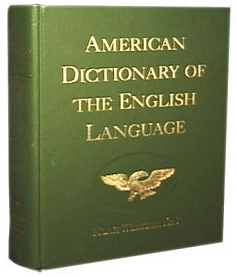
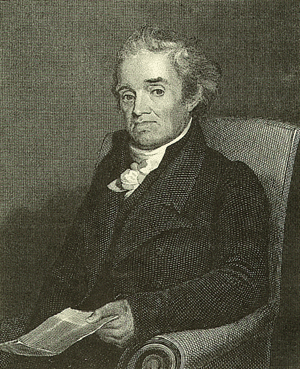
Noah Webster, the Father of American Christian education, wrote the first American dictionary and established a system of rules to govern spelling, grammar, and reading. This master linguist understood the power of words, their definitions, and the need for precise word usage in communication to maintain independence. Webster used the Bible as the foundation for his definitions.

This standard reference tool will greatly assist students of all ages in their studies.

No other dictionary compares with the Webster's 1828 dictionary. The English language has changed again and again and in many instances has become corrupt. The American Dictionary of the English Language is based upon God's written word, for Noah Webster used the Bible as the foundation for his definitions. This standard reference tool will greatly assist students of all ages in their studies. From American History to literature, from science to the Word of God, this dictionary is a necessity. For homeschoolers as well as avid Bible students it is easy, fast, and sophisticated.


Regards,


monte

{x:

Project:: 1828 Reprint


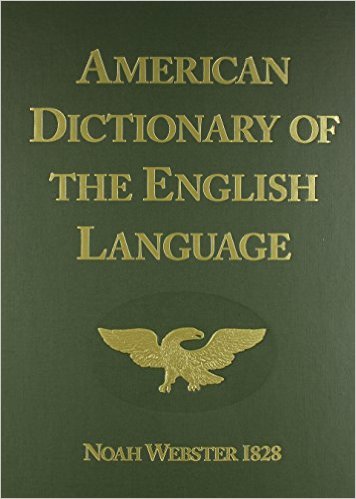
Hard-cover Edition

370

548

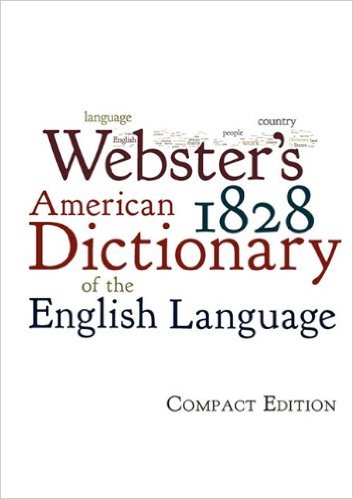
Compact Edition

355

246

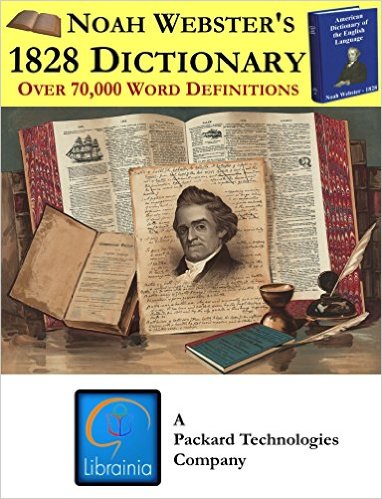
CD-ROM

305

193

* As a note, I have purchased each of these products. In fact, as we have been developing the Project:: 1828 Reprint, I have purchased several of the bulky hard-cover dictionaries. My opinion is that the 2000-page hard-cover edition is the only good viable solution at this time. The compact edition was a bit disappointing and the CD-ROM as well.


[ + ]
Add Search To Your Site


Our goal is to convert the facsimile dictionary (PDF available: v1 and v2) to reprint it and make it digitally available in several formats.

Overview of Project

  1. Image dissection
  2. Text Emulation
  3. Dictionary Formatting
  4. Digital Applications
  5. Reprint

Please visit our friends:

{ourFriends}

Learn more about U.S. patents:

{ourPatent}

Privacy Policy

We want to provide the best 1828 dictionary service to you. As such, we collect data, allow you to login, and we want your feedback on other features you would like.

For details of our terms of use, please read our privacy policy here.

Page loaded in 1.208 seconds. [1828: 22, T:0]


1828 Noah Webster Dictionary

^ return to top
Back to Top