HOME
SIGN UP LOGIN
https://1828.mshaffer.com
Monday - September 14, 2026

In my view, the Christian religion is the most important and one of the first things in which all children, under a free government ought to be instructed... No truth is more evident to my mind than that the Christian religion must be the basis of any government intended to secure the rights and privileges of a free people.
- Preface

1828 Noah Webster Dictionary
  A B C D E F G H I J K L M N O P Q R S T U V W X Y Z   <3

Search, browse, and study this dictionary to learn more about the early American, Christian language.

1828.mshaffer.comWord [signal]

0
0
Cite this! Share Definition on Facebook Share Definition on Twitter Simple Definition Word-definition Evolution

signal

SIG'NAL, n. [L. signum.] A sign that gives or is intended to give notice; or the notice given. Signals are used to communicate notice, information, orders and the like, to persons at a distance, and by any persons and for the purpose. A signal may be a motion of the hand, the raising of a flag, the firing of a gun, or any thing which, being understood by persons at a distance, may communicate notice.

Signals are particularly useful in the navigation of fleets and in naval engagements. There are day-signals, which are usually made by the sails, by flags and pendants, or guns; night-signals, which are lanterns disposed in certain figures, or false fires, rockets, or the firing of guns; fog-signals, which are made by sounds, as firing of guns, beating of drums, ringing of bells, &c. There are signals of evolution, addressed to a whole fleet, to a division or to a squadron; signals of movements to particular ships; and signals of service, general or particular. Signals used in an army are mostly made by a particular beat of the drum, or by the bugle.

SIG'NAL, a. Eminent; remarkable; memorable; distinguished from what is ordinary; as a signal exploit; a signal service; a signal ace of benevolence. It is generally but not always used in a good sense.


Evolution (or devolution) of this word [signal]

1828 Webster1844 Webster1913 Webster

SIG'NAL, n. [L. signum.] A sign that gives or is intended to give notice; or the notice given. Signals are used to communicate notice, information, orders and the like, to persons at a distance, and by any persons and for the purpose. A signal may be a motion of the hand, the raising of a flag, the firing of a gun, or any thing which, being understood by persons at a distance, may communicate notice.

Signals are particularly useful in the navigation of fleets and in naval engagements. There are day-signals, which are usually made by the sails, by flags and pendants, or guns; night-signals, which are lanterns disposed in certain figures, or false fires, rockets, or the firing of guns; fog-signals, which are made by sounds, as firing of guns, beating of drums, ringing of bells, &c. There are signals of evolution, addressed to a whole fleet, to a division or to a squadron; signals of movements to particular ships; and signals of service, general or particular. Signals used in an army are mostly made by a particular beat of the drum, or by the bugle.

SIG'NAL, a. Eminent; remarkable; memorable; distinguished from what is ordinary; as a signal exploit; a signal service; a signal ace of benevolence. It is generally but not always used in a good sense.


SIG'NAL, a.

Eminent; remarkable; memorable; distinguished from what is ordinary; as, a signal exploit; a signal service; a signal act of benevolence. It is generally but not always used in a good sense.


SIG'NAL, n. [Fr. signal; Sp. señal; from L. signum.]

A sign that gives or is intended to give notice; or the notice given. Signals are used to communicate notice, information, orders and the like, to persons at a distance, and by any persons and for any purpose. A signal may be a motion of the hand, the raising of a flag, the firing of a gun, or of any thing which being understood by persons at a distance, may communicate notice. Signals are particularly useful in the navigation of fleet and in naval engagements. There are day-signals, which are usually made by the sails, by flags and pendants, or guns; night-signals, which are lanterns, disposed in certain figures, or false fires, rockets, or the firing of guns; fog-signals, which are made by sounds, as firing of guns, beating of drums, ringing of bells, &c. There are signals of evolution, addressed to a whole fleet, to a division or to a squadron; signals of movements to particular ships; and signals of service, general or particular. Signals used in an army are mostly made by a particular beat of the drum, or by the bugle. – Mar. Dict. Encyc.


Sig"nal
  1. A sign made for the purpose of giving notice to a person of some occurence, command, or danger; also, a sign, event, or watchword, which has been agreed upon as the occasion of concerted action.

    All obeyed
    The wonted signal and superior voice
    Of this great potentate.
    Milton.

  2. Noticeable; distinguished from what is ordinary; eminent; remarkable; memorable; as, a signal exploit; a signal service; a signal act of benevolence.

    As signal now in low, dejected state
    As erst in highest, behold him where he lies.
    Milton.

  3. To communicate by signals] as, to signal orders.
  4. A token; an indication; a foreshadowing; a sign.

    The weary sun . . .
    Gives signal of a goodly day to-morrow.
    Shak.

    There was not the least signal of the calamity to be seen. De Foc.

  5. Of or pertaining to signals, or the use of signals in conveying information; as, a signal flag or officer.

    The signal service, a bureau of the government (in the United States connected with the War Department) organized to collect from the whole country simultaneous raports of local meteorological conditions, upon comparison of which at the central office, predictions concerning the weather are telegraphed to various sections, where they are made known by signals publicly displayed. -- Signal station, the place where a signal is displayed; specifically, an observation office of the signal service.

    Syn. -- Eminent; remarkable; memorable; extraordinary; notable; conspicuous.

  6. To notify by a signals; to make a signal or signals to; as, to signal a fleet to anchor.

    M. Arnold.
1828 Webster1844 Webster1913 Webster

Thank you for visiting!

  • Our goal is to try and improve the quality of the digital form of this dictionary being historically true and accurate to the first American dictionary. Read more ...
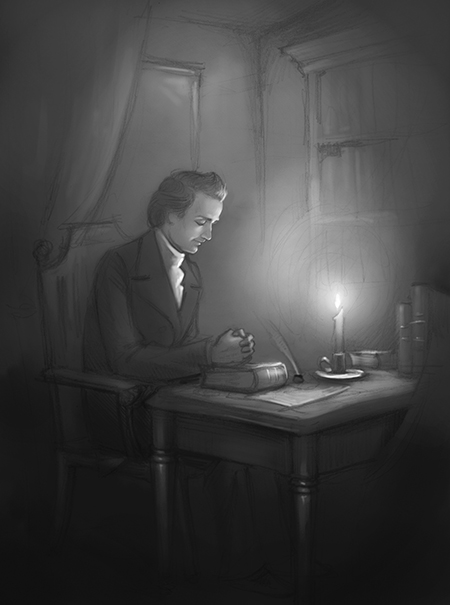
  • Below you will find three sketches from a talented artist and friend depicting Noah Webster at work. Please tell us what you think.
Divine Study
  • Divine StudyDivine Study
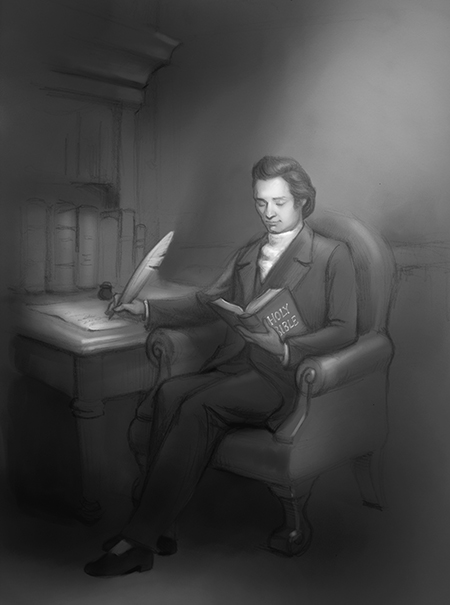
    Divine Study
Window of Reflection
  • Window of ReflectionWindow of Reflection
    Window of Reflection
Enlightening Grace
  • Enlightening GraceEnlightening Grace
    Enlightening Grace

164

952

126

1036

199

1075
Signal

SIG'NAL, noun [Latin signum.] A sign that gives or is intended to give notice; or the notice given. Signals are used to communicate notice, information, orders and the like, to persons at a distance, and by any persons and for the purpose. A signal may be a motion of the hand, the raising of a flag, the firing of a gun, or any thing which, being understood by persons at a distance, may communicate notice.

Signals are particularly useful in the navigation of fleets and in naval engagements. There are day-signals, which are usually made by the sails, by flags and pendants, or guns; night-signals, which are lanterns disposed in certain figures, or false fires, rockets, or the firing of guns; fog-signals, which are made by sounds, as firing of guns, beating of drums, ringing of bells, etc. There are signals of evolution, addressed to a whole fleet, to a division or to a squadron; signals of movements to particular ships; and signals of service, general or particular. Signals used in an army are mostly made by a particular beat of the drum, or by the bugle.

SIG'NAL, adjective Eminent; remarkable; memorable; distinguished from what is ordinary; as a signal exploit; a signal service; a signal ace of benevolence. It is generally but not always used in a good sense.

Why 1828?

Word of the Day

importance

IMPORT'ANCE, n.

1. Weight; consequence; a bearing on some interest; that quality of any thing by which it may affect a measure, interest or result. The education of youth is of great importance to a free government. A religious education is of infinite importance to every human being.

2. Weight or consequence in the scale of being.

Thy own importance know.

Nor bound thy narrow views to things below.

3. Weight or consequence in self-estimation.

He believes himself a man of importance.

4. Thing implied; matter; subject; importunity. [In these senses, obsolete.]

Random Word

on

ON, pre. [L. in; Gr. Hence they denote nearness, closeness or contiguity, and from meeting the Latin in and the English un have their power of negation or opposing.]

1. Being in contact with the surface or upper part of a thing and supported by it; placed or lying in contact with the surface; as, my book is on the table; the table stands on the floor; the house rests on its foundation; we lie on a bed, or stand on the earth.

2. Coming or falling to the surface of any thing; as, rain falls on the earth.

Whosoever shall fall on this stone, shall be broken.

Matt. 21.

3. Performing or acting by contact with the surface, upper part or outside of anything; as, to play on a harp, a violin, or a drum.

4. Noting addition; as heaps on heaps; mischief on mischief; loss on loss.

5. At or near. When we say, a vessel is on shore, we mean that she is aground; but when we say, a fleet on a ship is on the American coast, or an isle is situated on the coast of England, we mean only that it is near the coast. So we say, on each side stands an armed man, that is, at or near each side.

So we say, Philadelphia is situated on the Delaware; Middlebury is on the Otter Creek; Guilford stands on the Sound; that is, near the river or Sound, instead of on the bank, side or shore.

6. It denotes resting for support; as, to depend on, to rely on; hence, the ground of any thing; as, he will covenant on certain considerations or conditions; the considerations being the support of the covenant.

7. At or in the time of; as, on the sabbath we abstain from labor. We usually say, at the hour, on or in the day, in or on the week, month or year.

8. At the time of, with some reference to cause or motive. On public occasions, the officers appear in full dress or uniform.

9. It is put before the object of some passion, with the sense of towards or for. Have pity or compassion on him.

10. At the peril of, or for the safety of. Hence, on thy life.

11. Denoting a pledge or engagement, or put before the thing pledged. He affirmed or promised on his word, or on his honor.

12. Noting imprecation or invocation, or coming to, falling or resting on. On us be all the blame.

His blood be on us, and on our children. Matt. 27.

13. In consequence of, or immediately after. On the ratification of the treaty, the armies were disbanded.

14. Noting part, distinction or opposition; as on one side and on the other. On our part, expect punctuality.

On the way, on the road, denote proceeding, traveling, journeying, or making progress.

On the alert, in a state of vigilance or activity.

On high, in an elevated place; sublimely.

On fire, in a state of burning or inflammation, and metaphorically, in a rage or passion.

On a sudden, suddenly.

On the wing, in flight; flying; metaphorically, departing.

On it, on't, is used for of it. I heard nothing on't. the gamester has a poor trade on't. [This use is now vulgar.]

Upon is used in the same sense with on, often with elegance, and frequently without necessity or advantage.

ON, adv.

1. Forward, in progression; as, move on; go on.

2. Forward, in succession. From father to son, from the son to the grandson, and so on.

3. In continuance; without interruption or ceasing; as, sleep on, take your ease; say on; sing on; write on.

4. Adhering; not off; as in the phrase, "he is neither on nor off," that is, he is not steady; he is irresolute.

5. Attached to the body; as, his clothes are not on.

To put on, to attach to the body, as clothes or arms.

On, when it expresses contact with the surface of a thing, is opposed to under, off, or within, and when it expresses contact with the side of a thing, is opposed to off.

On is sometimes used as an exclamation, or rather as a command to move or proceed, some verb being understood; as, cheerily on, courageous friends; that is, go on, move on.

Noah's 1828 Dictionary

First dictionary of the American Language!

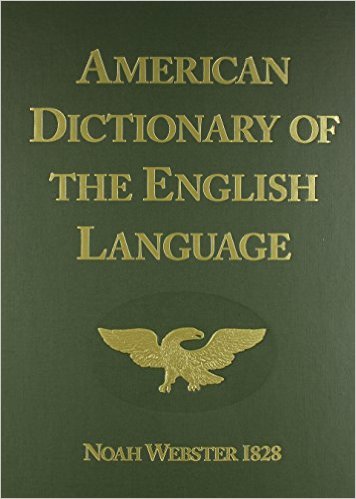
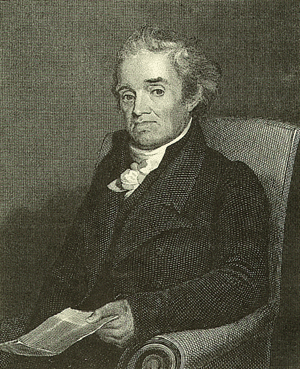
Noah Webster, the Father of American Christian education, wrote the first American dictionary and established a system of rules to govern spelling, grammar, and reading. This master linguist understood the power of words, their definitions, and the need for precise word usage in communication to maintain independence. Webster used the Bible as the foundation for his definitions.

This standard reference tool will greatly assist students of all ages in their studies.

No other dictionary compares with the Webster's 1828 dictionary. The English language has changed again and again and in many instances has become corrupt. The American Dictionary of the English Language is based upon God's written word, for Noah Webster used the Bible as the foundation for his definitions. This standard reference tool will greatly assist students of all ages in their studies. From American History to literature, from science to the Word of God, this dictionary is a necessity. For homeschoolers as well as avid Bible students it is easy, fast, and sophisticated.


Regards,


monte

{x:

Project:: 1828 Reprint


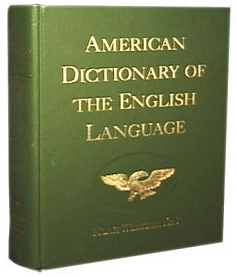
Hard-cover Edition

382

564

Compact Edition

369

257

CD-ROM

325

201

* As a note, I have purchased each of these products. In fact, as we have been developing the Project:: 1828 Reprint, I have purchased several of the bulky hard-cover dictionaries. My opinion is that the 2000-page hard-cover edition is the only good viable solution at this time. The compact edition was a bit disappointing and the CD-ROM as well.


[ + ]
Add Search To Your Site


Our goal is to convert the facsimile dictionary (PDF available: v1 and v2) to reprint it and make it digitally available in several formats.

Overview of Project

  1. Image dissection
  2. Text Emulation
  3. Dictionary Formatting
  4. Digital Applications
  5. Reprint

Please visit our friends:

{ourFriends}

Learn more about U.S. patents:

{ourPatent}

Privacy Policy

We want to provide the best 1828 dictionary service to you. As such, we collect data, allow you to login, and we want your feedback on other features you would like.

For details of our terms of use, please read our privacy policy here.

Page loaded in 1.264 seconds. [1828: 22, T:0]


1828 Noah Webster Dictionary

^ return to top
Back to Top